
As different interpretations of these ideas spread across the East, Buddhist practitioners began to create meditation rituals around them. Meditation and mindfulness are almost inseparable, as meditation is often used to achieve mindfulness.
In Buddhism, the practice of meditation and mindfulness are used to detach a person from certain thoughts, with the ultimate goal of dissolving the ego. By examining emotional thoughts without judgement, it is easier to let them go. Even though this may seem counterintuitive, many historical accounts indicate that peace within oneself allows for more focus on the present moment.
Evidence of similar ideas were found in the west around the 16th century, but it was not until the 20th century that mindfulness and meditation took hold in western culture.
Eastern meditative ideas entered the western zeitgeist in the 1960s and 1970s. From the space race to the Civil Rights Movement, this was a time of radical cultural and social change that facilitated the integration of new spiritual beliefs.
As Transcendental Meditation became a highly successful movement, psychologists began to study its effects and use it within their own practices. In 1979, Jon Kabat-Zinn used knowledge from the teachings of Thich Nhat Hanh, a Vietnamese monk, to create a program called Mindfulness-Based Stress Reduction.
The program recognized the mental benefits of meditation, but disregarded its religious history. Furthermore, the way we think of mindfulness and meditation in western culture is often not associated with religion, but rather a general feeling of spirituality. Even though the concepts may not always be affiliated with religion, it is still important to understand how they came about in our culture.
In the following decades after Mindfulness-Based Stress Reduction was invented, psychologists refined meditation and mindfulness into different modes of therapy. Ultimately, this benefitted the scientific field by finding proven tactics to reduce depression and other behavioral issues.
Mindfulness is a key component to Cognitive Behavioral Therapy, a highly successful structured form of talk therapy. To put it simply, Cognitive Behavioral Therapy allows patients to examine their thoughts critically to identify unhelpful or toxic thought patterns, thus strengthening their mindfulness and self-awareness.
What About Pilates?
Historical debrief aside, what does mindfulness have to do with Pilates?
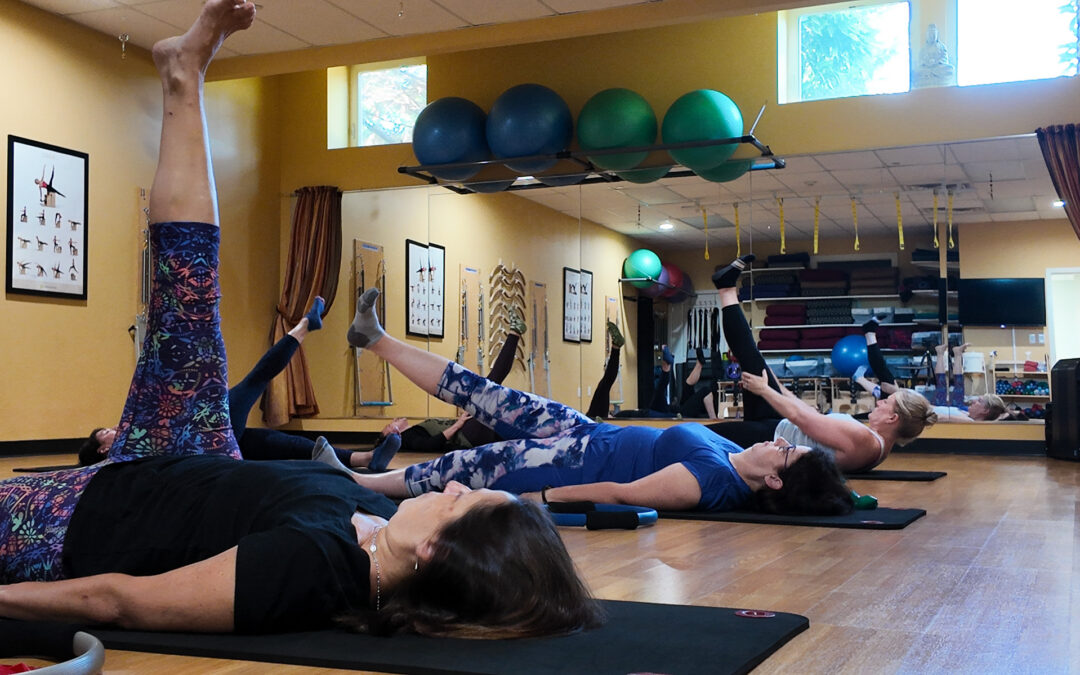
At the center of it all, people who practice Pilates are moving towards one goal: awareness of how their own body works. The body is like a complex machine full of moving pieces, each Pilates exercise targeting a different section. While it may not be possible to be aware of each and every piece at the same time, one Pilates exercise may make one target area come into focus.
Much like meditation, one of the first things that we learn in Pilates is to breathe. Intentional breathing is the first step to full-body awareness because it helps you to track how your body is reacting to a movement.
Pilates practitioners also consistently highlight the “mind-body connection”, a very important concept for self-awareness. Knowing what you’re doing right, and knowing what a movement should feel like reflects a greater understanding of how things work within your body. Acknowledging and accepting your individual experiences with movement allows you to see how that movement can be improved.
Of course, every moment of awareness, whether good or bad, should be received without judgement. Judging ourselves based on our individual capabilities is a reflection of the ego, which must be minimized in order to make progress. True mindfulness seeks to improve current circumstances without the self-deprecating label of “not good enough”.
This can explain why Pilates has such enormous mental health benefits as well. The context of mindfulness, not only from a clinical perspective, but also from a historical perspective, heavily suggests that these practices reduce mental tension.
A unity with oneself separates us from material stressors, even if only for an hour long Pilates class. This might be exactly what you need to ground yourself and reorganize your thoughts. If you have ever wondered why you feel so refreshed after a Pilates class, maybe it’s because you accidentally engaged in a meditative practice!
Next time you walk into your Pilates session, think back to the thousands of years that people have been practicing mindfulness and know that you are a part of that history too. As you search for your own awareness, remember that it all starts with one intentional breath.
References
The Origins and History of Mindfulness
Meditation | Definition, History, & Facts | Britannica
What Is Cognitive Therapy and How Does It Work? – ScienceInsights