Unlike Reformer or CoreAlign classes, Pilates Mat Classes have stayed out of the limelight. Without any complex apparatus involved, mat class seems like a simpler alternative for Pilates. Unfortunately, this can make Mat Pilates a less popular option.
It is true that Reformer and CoreAlign classes have a surplus of benefits that make them a good fit for anyone. There is no denying that these forms of Pilates will target different areas of the body, and, depending on your goals, may make them a more ideal choice for you. This article does not aim to dissuade you from taking the classes you enjoy, but to highlight an often underrepresented form of Pilates. You may find that a Pilates Mat Class is the best option to suit your needs!
Before getting into the unique benefits of a Pilates Mat Class, it is important to understand where the idea came from. After all, Mat Class in the modern age looks a lot different than it did in its inception. Despite its changes over time, the central concepts remain intact.
Classical Mat Pilates
Many in the Pilates community are familiar with the origins of the Reformer. As Joseph Pilates was refining his idea of Contrology, which would later become Pilates, he took inspiration from bedridden and injured soldiers during World War 1. With the goal of improving their strength and mobility, Pilates used bed springs to allow the soldiers to exercise while laying down.
Unlike the Reformer, Classical Mat Pilates does not seem to have a moment of invention, rather, it is more of a development of ideas over time. Joseph Pilates’ ideas conglomerated into the concept of Contrology during the 1920s and 1930s. It was during these decades that mat exercises were introduced.
Pilates published his first work, Your Health, in 1934 which was the first written description of his ideas about Mat Pilates. Even so, Your Health focused more on defining the science of Contrology, rather than delving deep into the specifics of mat. It was not until 1945, when Pilates published Return to Life Through Contrology, that a full list of original mat exercises was released.
In Return to Life, Pilates described 34 mat exercises that must be practiced in order and with intention. These exercises were so revolutionary that they transcended the community of Pilates. Anyone looking for a good ab workout will likely know about the “Hundred” or the “Jacknife”. These were both original mat exercises by Joseph Pilates.
Though these exercises may be taken out of context or inspire other forms of movement today, Pilates described and ordered them for a specific purpose. The 34 exercises start with the “Hundred” which activates the core and challenges a person to maintain rhythmic and steady breathing. Pilates starts with this, presumably because the foundation of Pilates sits upon the idea of correct breathing.
The rest of Pilates’ 34 mat exercises ramp up into more difficult movements that require balance, stability, and, most importantly, core strength. The concept of a strong center of gravity is a popular motif with Mat Pilates, making it a good choice for those looking to improve their core stability.
It is also important to note that these exercises only require two things: yourself and a mat. These exercises are convenient, accessible, and can even be done at home. Other forms of Pilates can help increase awareness of your body, but Classical Mat Pilates necessitates that you rely only on yourself.
Modern Mat Pilates: Similarities and Differences
It has been about a hundred years since Joseph Pilates began working on his idea of Contrology. Since then, Pilates Mat has evolved in many ways, but the foundation is still a central part of modern Pilates teachings. If you walk into a Pilates mat class today, you may encounter more than just a mat.
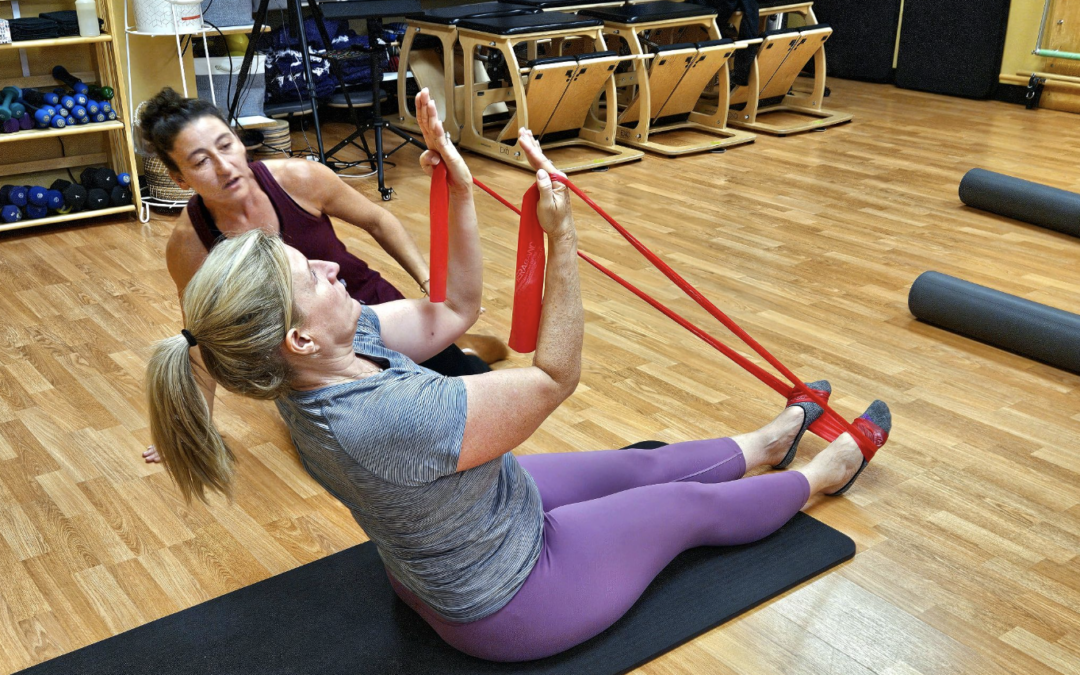
Many smaller props are often used in the mat classes of today, for example, the Theraband. The Theraband is a strip of elastic material that creates a similar resistance effect as the springs of a Reformer. It can also provide support in certain mat movements.
Support from these props is not essential to mat work, but they can provide more options for those who are working up to an exercise. Props like the Theraband can show you how a Pilates exercise is supposed to feel in your body, which can prevent strain and injury. Props are useful tools if you need extra support in a movement, but they can also facilitate your growth into doing the movement without any assistance.
Modern mat classes can also take on a “fusion” aspect in which props and other equipment are essential to the class. At Pilates Core Center, the Arcus tower is an apparatus that is frequently used in our Pilates Fusion Tower Mat Class.
The Arcus itself is a curved wooden bar that mimics the natural shape of human bones. It connects to metal springs which attach to a wall. Again, this piece of equipment is similar to the Theraband and the Reformer in that it can provide both resistance and support. The Arcus can be held with feet or hands, standing or sitting, providing a wide range of exercises to explore.
It may seem as though there is a large deviation from the Pilates’ Classical Mat, but these original concepts of core strength, mobility, and stability still carry through. A great example to demonstrate this is with one of Pilates’ original 34 exercises: the Roll Up.
Unassisted, it is common for people practicing the Roll Up to neglect their core, instead opting to use their neck and back muscles to bring themselves up. Reliance on back muscles in place of core strength is a common culprit of long-term back pain. Holding the Arcus bar when doing a Roll Up helps to relax the neck and shoulders, directing tension to the core. It is one thing to explain the correct way to do a movement, but it can be even more helpful to feel the correct movement.
Mat Pilates proves to be one of the most accessible ways to do Pilates, no matter what you are struggling with physically. If you want to feel confident in your stability, give Mat Pilates a try. Even if you don’t have time for an hour-long class, completing a few of the original exercises at home will make all the difference.