It is no secret that the phrase “mind-body connection” appears frequently in the world of Pilates. Oftentimes this phrase refers to an intentional awareness of one’s own body when engaging in movement. The connection between these two facets enhances the movement and simultaneously broadens our understanding of our capabilities.
Though this is an accurate description of the mind-body connection, it does not paint a complete picture. What many people do not realize is that Pilates is designed around this concept. It is one of the only forms of movement in which props are utilized as tools to improve the connection between the physical and the mental.
The Arcus Bar is a perfect way to illustrate this idea. This piece of equipment is a wooden bar with two distinct curves, almost in the shape of an archer’s bow. It can be used as a prop in many different exercises, and it targets different parts of the body depending on a person’s hand placement.
The Arcus can be used in a similar way to the Roll-Back Bar, but it provides more control and variety to the movement. Unlike the Arcus, the Roll-Back Bar does not mimic the naturally curved shape of our bones, which limits one’s awareness of the body.
Knowing more about the history and foundation of the Arcus Bar will not only increase your understanding of the equipment, it will also give you more insight into the topic of mind-body connection.
The Neurological Connection
Joseph Pilates is credited with inventing most of the Pilates concepts that we know and love today. Despite this, Pilates has evolved drastically since its inception. Modern pioneers have created their own techniques and equipment based on current science.
One of these modern pioneers is Trent McEntire, a dancer who understood the brain’s impact on physical education through his own lived experience. McEntire was born with Class 1 Cerebral Palsy, a neurological condition that impacts brain development and subsequently causes restricted movement. McEntire felt his physical limitations, but this did not stop him from enjoying physical activity. Not being aware of his condition until the age of 19, McEntire participated in a wide range of sports.
Despite experiencing difficulties with his mobility and endurance, McEntire had undeniable talent, strength, and determination. He enrolled in the dance program at Western Michigan University, which required him to dance up to 45 hours a week.
College was also the first place McEntire tried Pilates. The piece, The Right Attitude, by Trent McEntire details his experience with finally being aware of his movement through his first Pilates class. The cues helped him understand our bodies as a complete whole, with no part acting individually. McEntire used his newfound knowledge to complete a dance requiring an arm movement that he had struggled with his entire life.
McEntire has now led a successful career in both dance and Pilates. With the understanding of movement relying on the brain instead of the body, McEntire has developed pieces of Pilates equipment that help others connect to their brain.
In The Right Attitude, McEntire states that he loved anything to do with the Pilates Cadillac. Maybe this passion is what inspired him to create the Arcus, an expansion of the Roll-Back bar that helped his own spine. McEntire says that the Arcus helps people with their own sets of limitations. By using some basic Arcus exercises, we will show how the Arcus actually works.
Arcus Principles
One of the 10 McEntire Movement Principles is to follow the Chain of Command Approach. This approach hearkens back to McEntire’s story of performing Swan Lake. In order to lift his partner over his head, he activated his feet and abdominals first. This underlying support allowed his body to work in tandem with itself and complete the move.
The Chain of Command Approach involves checking in on these foundational aspects of a movement, rather than putting physical stress in one place. McEntire’s Cerebral Palsy and career as a dancer made him aware of the feet as one of the most important places in the Chain of Command.
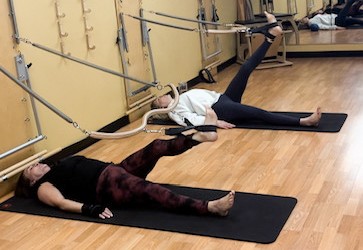
The “Ankles to Inner Thigh” exercise is a great example of how to connect the feet to the rest of the body with the Arcus. This exercise is performed laying on the back in a relaxed, natural position, and placing the feet into flexible loops that are attached to the Arcus. The Arcus is held close to the chest to maintain tension in the feet and legs. The legs then open and close gently.